Mexico has cemented its status as one of the world’s foremost destinations for remote professionals. Its unique blend of vibrant culture, stunning biodiversity, affordable cost of living, and proximity to North America has made it a top choice for those looking to blend work and travel seamlessly.
The path to long-term residency for remote workers in Mexico is secured through the Mexico Temporary Resident Visa, a scheme that functions as the country’s de facto Mexico digital nomad visa. This visa is meticulously designed to welcome individuals who earn their income from sources outside of Mexico, making it a perfect match for freelancers, remote employees, and business owners.
This comprehensive guide will demystify the entire process, from understanding the core requirements and navigating the rigorous application steps to providing a detailed look at the thriving digital nomad lifestyle awaiting you in this incredible nation.
Understanding the Mexico Digital Nomad Visa (Temporary Resident Visa)
The official name for the permit that allows remote workers to live long-term in Mexico is the Temporary Resident Visa. Although it is not specifically branded as a “Digital Nomad Visa” like schemes in other nations, its conditions—specifically the mandate that all income must be earned outside of Mexico—make it the essential immigration pathway for the global digital workforce.
We will refer to this as the Mexico digital nomad visa throughout this guide to align with common terminology and your search criteria.
Key Features and Duration
| Feature | Detail |
| Official Name | Temporary Resident Visa (Visa de Residente Temporal) |
| Initial Validity | 1 Year |
| Maximum Stay | Up to 4 years (through annual renewals within Mexico) |
| Employment Condition | Cannot work for any company or client based in Mexico (must be foreign-sourced income). |
| Dependents | Holders can bring spouses, common-law partners, and dependent children. |
| Pathway to PR | After 4 consecutive years, the holder may apply for Permanent Residency. |
The most critical distinction of this visa is the prohibition on local employment. The Mexican government welcomes foreign income spent within its economy but reserves local jobs for its citizens and legal residents with a work permit. For the digital nomad earning entirely from overseas clients or a foreign employer, this condition is perfectly met.
The Rise of the Digital Nomad Visa Concept
To fully appreciate the Mexican scheme, it is helpful to define the “digital nomad visa” category. These specialized visas are designed to:
- Formalize Long Stays: Offer a legal way for remote workers to stay in a country for longer than a standard tourist visa (typically 90-180 days).
- Boost Local Economies: Attract high-earning foreign individuals to inject spending power into the local economy without competing for local jobs.
- Establish Residency (Temporary): Grant the holder the right to live, rent property, and enroll children in schools, something a tourist visa often prohibits.
Mexico joins a competitive field of countries, particularly in Latin America and the Caribbean, that cater to this unique demographic. Other notable options include the visas offered by Brazil, Curaçao, and Barbados, though Mexico’s scheme is widely regarded as one of the most established and straightforward.
💵 Mexico Digital Nomad Visa Requirements: Financial Solvency
The cornerstone of the Mexico digital nomad visa application is proving economic solvency. You must convincingly demonstrate that you have the financial means to support yourself and any dependents for your entire stay without working for a Mexican entity.
The requirements are calculated based on Mexico’s daily minimum wage (or Unidad de Medida y Actualización – UMA), meaning the exact dollar amounts are subject to change, but they consistently fall into two main pathways: Monthly Income or Savings Balance. Applicants must meet one of these two primary criteria.
Disclaimer: The following financial figures are approximate and based on recent consulate reporting. Always confirm the exact, current requirements with the specific Mexican Consulate where you plan to apply, as they can enforce minor variations.
Pathway 1: Consistent Monthly Income
Applicants must demonstrate a consistent minimum net monthly income for a period preceding the application—typically the last 6 or 12 months (check with your consulate).
| Applicant Type | Approximate Net Monthly Income Requirement (USD) | Source Documentation |
| Main Applicant | $\approx \$4,400 – \$4,700$ USD | Last 6-12 months of official, bank-stamped, and signed bank statements/pay stubs. |
| Each Dependent (Spouse/Child) | Add an additional $\approx \$850 – \$900$ USD per person. | The main applicant must demonstrate this additional amount. |
Crucial Documentation Detail: Consulates are often strict that these documents must be original, bank-stamped, or officially signed by a bank officer. Plain electronic printouts of online statements are frequently rejected. The income must show consistent, recurring deposits (salary, client payments, or pensions) and be net (after taxes).
Pathway 2: Substantial Savings or Investments
If your monthly income is variable or you prefer to qualify via your net worth, you can meet the requirement through a substantial average balance in a checking, savings, or investment account.
| Applicant Type | Approximate Average Daily Balance Requirement (USD) | Source Documentation |
| Main Applicant | $\approx \$74,000 – \$78,000$ USD | Last 12 months of official, bank-stamped, and signed bank/investment statements. |
| Each Dependent (Spouse/Child) | Add an additional $\approx \$1,500$ USD for the first dependent, then an additional $\approx \$850 – \$900$ USD for subsequent dependents. (Varies by consulate). | The main applicant must demonstrate this additional amount. |
Key Detail: The consulate will scrutinize the average daily balance over the entire 12-month period, not just the ending balance. This prevents applicants from depositing a large sum right before applying.
Pathway 3: Mexican Property Ownership (Less Common)
While less common for the typical digital nomad, you can also qualify if you own real estate in Mexico valued at a substantial minimum, often in excess of $600,000 USD.
General Document Requirements
Beyond financial proof, every applicant must prepare the following core documents, all of which should be in English or Spanish, or include an official translation:
- Valid Passport: Must be valid for at least six months beyond your application date.
- Visa Application Form: Completed and signed, often required to be printed double-sided on a single sheet.
- Passport-Sized Photo: A recent photo (specifications vary, often $\approx 3.9$ cm x $3.1$ cm, white background, no glasses).
- Proof of Legal Status: If applying from a country where you are not a citizen (e.g., Green Card, residence permit).
- Marriage/Birth Certificates: Required if applying with dependents (often need to be Apostilled).
- Letter of Intent: A brief, signed letter explaining your purpose for residing in Mexico (e.g., remote work, cultural exploration).
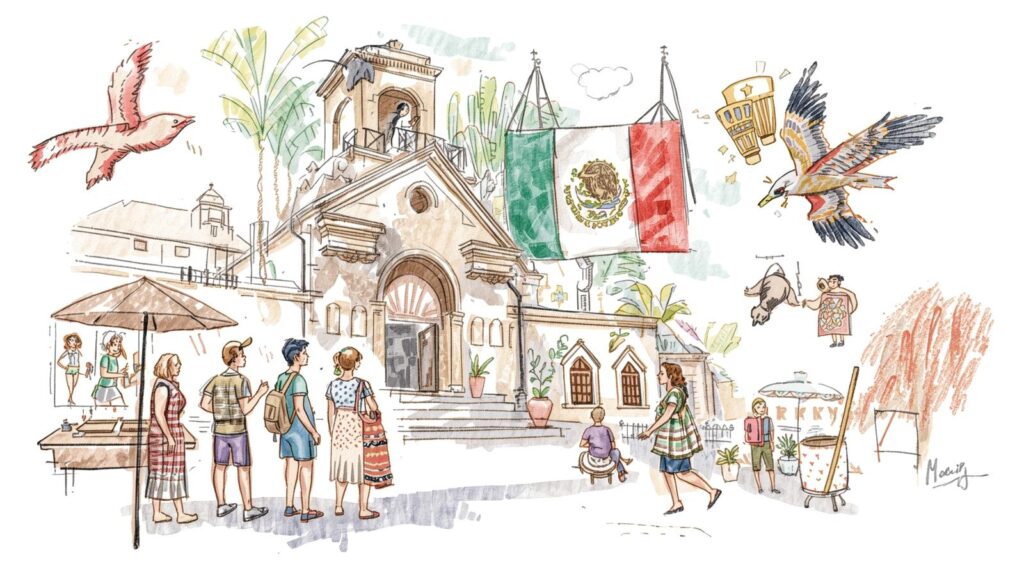
📝 The Mexico Digital Nomad Visa Application Process: A Two-Part Journey
The application for the Mexico digital nomad visa is a critical two-part process that must be initiated outside of Mexico.
Part 1: The Consular Application (Outside Mexico)
This stage involves interacting with a Mexican embassy or consulate in your country of citizenship or legal residence.
Step 1: Scheduling the Visa Appointment
The primary challenge for many applicants is securing an appointment. Due to the popularity of Mexico, consulates worldwide often have long wait times, sometimes extending to several weeks or even a few months.
- Action: Contact the closest Mexican embassy or consulate and request an appointment for a Temporary Resident Visa for Economic Solvency.
- Pro-Tip: Some consulates use an online booking system (MiConsulado), while others prefer email or phone. Be persistent and flexible with your date. Do not schedule your appointment until you have all your financial documents finalized.
Step 2: Document Gathering and Application Completion
Ensure every document listed in the requirements section above is ready, including the required copies, official bank stamps, and translations. Incomplete applications are the leading cause of rejection or delay.
Step 3: Attending the Visa Appointment and Interview
This is a mandatory in-person visit. You will:
- Submit all documents for a review by a consular officer.
- Pay the non-refundable application fee ($\approx \$50-\$60$ USD, typically cash or money order only).
- Undergo a brief interview regarding your eligibility, source of income, and plans in Mexico. Be prepared to clearly and confidently explain your remote work (e.g., “I work as a software engineer for a company based in San Francisco, and all my salary is paid into my US bank account.”).
Step 4: Visa Issuance
If approved, the consulate will place a one-year Temporary Resident Visa stamp inside your passport. The processing time can be immediate or take up to a few weeks, depending on the consulate. Once this stamp is in hand, you have 180 days to travel to Mexico.
Part 2: Registering Residency (Inside Mexico)
The visa stamp in your passport is not your resident card. It is merely permission to enter Mexico and start the process of obtaining the physical card. This second phase must be completed within the first 30 days of your arrival.
Step 5: Entry and INM Registration
Upon arrival in Mexico, you must tell the immigration officer at the airport/border that you are entering on a visa for Canje (exchange) or Trámite de Residente Temporal. The officer will stamp your passport and may give you an FMM (tourist card) marked specifically for this purpose.
Within 30 days of entry, you must visit a local office of the Instituto Nacional de Migración (INM)—Mexico’s immigration authority.
Step 6: Submitting Final Documents and Biometrics
At the INM office, you will:
- Submit the required internal forms and documents (including copies of your visa, passport, and the INM entry stamp).
- Provide a new set of passport-sized photos (check the specific requirements—they are different from the consulate’s).
- Pay the final fee for the Temporary Resident Card (cost varies by duration but is typically a few hundred USD).
- Have your biometrics (fingerprints and photo) taken.
Step 7: Receiving the Resident Card
The INM will issue you a physical Temporary Resident Card. This card is your official ID for your stay in Mexico, valid for one year. You must carry this card and use it for any future travel in and out of the country.
Renewal Path: After the first year, you can renew the card inside Mexico for an additional 1, 2, or 3 years, up to the four-year maximum. The renewal process is handled entirely through the INM and requires a similar—though often less stringent—proof of economic solvency.
🌎 Life as a Digital Nomad in Mexico: Connectivity, Culture, and Cost
The Mexico digital nomad visa opens the door to a diverse and rich lifestyle. Remote workers flock to Mexico not just for the legal pathway, but for the tangible benefits of daily life.
Cost of Living Comparison
Mexico remains an affordable global hub, though prices in major expat destinations have risen. A comfortable mid-range monthly budget for a single person typically falls between $1,500 and $2,500 USD, depending heavily on the chosen city and accommodation style.
| City | Vibe & Location | Monthly Cost Estimate (Mid-Range Single) | Internet Speed/Quality |
| Mexico City (CDMX) | Global metropolis, cultural hub, high altitude. | $\approx \$1,800 – \$2,500+$ | Excellent (Fiber available, 50-200 Mbps) |
| Playa del Carmen | Caribbean beach town, party atmosphere, heavy expat community. | $\approx \$1,500 – \$2,200+$ | Very Good (Fiber optic widely available) |
| Oaxaca City | Cultural and culinary capital, relaxed, great for budget travelers. | $\approx \$1,200 – \$1,800$ | Decent (Improving, sometimes spotty outside center) |
| Puerto Vallarta | Pacific coast beach, mountain backdrop, large LGBTQ+ and retiree community. | $\approx \$1,500 – \$2,200$ | Good (Fiber available in central areas) |
Accommodation is often the biggest variable. While a long-term lease in a non-tourist neighborhood of CDMX might cost $700, a short-term luxury Airbnb in Tulum could easily cost $2,000+.
Connectivity and Infrastructure
Reliable high-speed internet is the lifeblood of the digital nomad. Mexico generally excels in this regard, especially in large cities and designated digital nomad hotspots.
- Wired Internet: Fiber-optic services from providers like Telmex (Infinitum) and TotalPlay offer speeds well over 100 Mbps in major urban areas.
- Mobile Hotspots: Excellent 4G and 5G coverage is standard in most populated regions, with carriers like Telcel and AT&T providing affordable data packages.
- Coworking Spaces: From sleek, modern offices in Roma Norte (CDMX) to beachfront spots in Playa del Carmen, the coworking culture is robust, providing professional amenities and networking opportunities.
Culture and Travel
Mexico’s immense size and rich history offer a new experience around every corner. Visa holders can take advantage of living there to:
- Explore Ancient Civilizations: Visit Mayan ruins like Chichén Itzá and Palenque or the Aztec wonders of Teotihuacán.
- Immerse in Festivals: Experience cultural highlights like Día de Muertos (Day of the Dead) or regional carnavales.
- Enjoy Connectivity: Major, affordable bus lines like ADO connect large cities, and numerous international airports make regional travel seamless.
⚖️ Mexico Digital Nomad Visa and Tax Implications (The 183-Day Rule)
One of the most complex and critical aspects of holding the Mexico digital nomad visa is understanding your potential tax liability. A Temporary Resident Card does not automatically make you a tax resident, but your time in the country does.
The Standard 183-Day Rule
Under Mexican law, you are generally considered a Mexican Tax Resident if you are physically present in the country for more than 183 calendar days (six months) in any calendar year.
- Consequence of Tax Residency: Once classified as a tax resident, Mexico operates on a worldwide income tax system. This means you are potentially liable for Mexican income tax on all your earnings, regardless of whether the income is sourced from outside the country. Mexican tax rates are progressive, ranging from 1.92% to 35%.
Avoiding Double Taxation
The primary mechanism for digital nomads to avoid being taxed in both their home country and Mexico is through Double Taxation Agreements (DTAs). Mexico has DTAs with dozens of countries, including the US, Canada, and most EU member states.
These treaties generally contain a “tie-breaker” clause that determines which country has the primary right to tax you. For most remote workers, the tie-breaker is based on the location of your “center of vital interests” (where you have your family, home, and main economic ties) or where you spend the majority of your time.
Crucial Tax Note for Remote Workers:
If you spend more than 183 days in Mexico, you must consult with a tax professional specializing in international expatriate tax law. Simply earning money from a foreign company does not exempt you from worldwide taxation once you cross the 183-day threshold. Failure to register and file as a tax resident can lead to significant penalties.
🌟 Final Thoughts and Next Steps for Your Mexican Journey
The Mexico Temporary Resident Visa is a highly effective, albeit demanding, path for long-term remote work in one of the world’s most compelling countries. The high financial requirements ensure that those who successfully apply are serious, financially stable individuals ready to contribute positively to the local economy.
By meticulously preparing your financial documentation, approaching the consular process with patience, and understanding your responsibilities as a long-term resident, you can successfully secure your Mexico digital nomad visa and unlock up to four years of adventure.
Need Specialized Assistance?
Navigating the nuances of consular requirements, document apostilles, and the intricate INM process can be overwhelming. Many applicants choose to work with specialized immigration consultants or lawyers to ensure all steps are followed perfectly, minimizing the risk of a time-consuming rejection.
Would you like me to find some current and highly-rated immigration and visa services that specialize in the Mexico Temporary Resident Visa process?