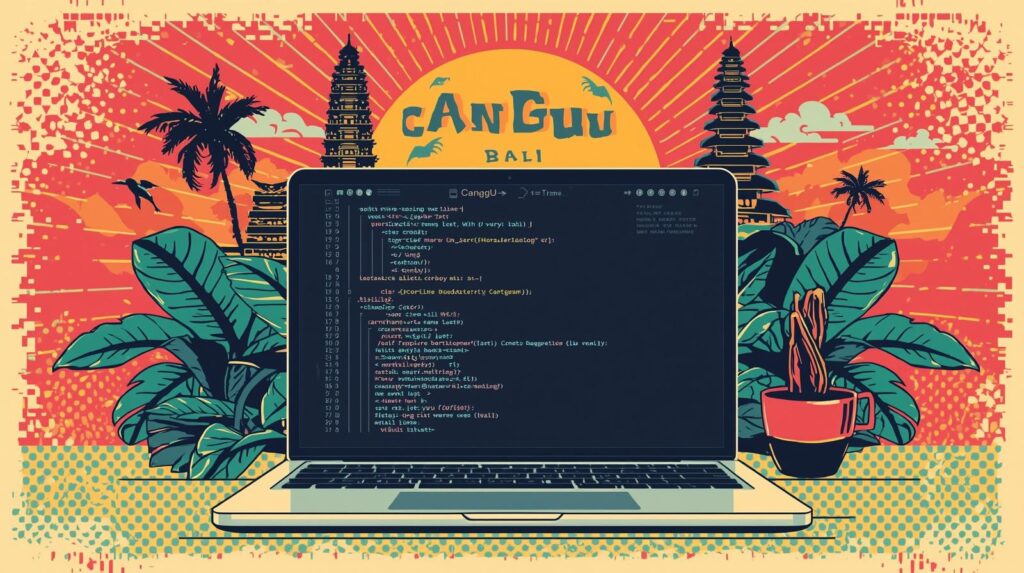
Canggu, Bali. The name itself conjures images of rice paddies meeting the ocean, sunset surf sessions, and vibrant café culture. For web developers and coders, it’s more than just a tropical paradise—it’s the definitive hub for the Asian digital nomad scene. The promise is clear: you can maintain a high-earning, intellectually stimulating web development work for nomads career while living a life defined by freedom and culture.
But the success stories of coding in Canggu are built on more than just a strong Wi-Fi signal. They require strategic job hunting, mastery of specialized tech stacks, meticulous compliance with the latest Indonesian visa laws (especially the Remote Worker KITAS), and a disciplined approach to productivity.
This comprehensive guide is your blueprint to securing and thriving in in-demand web development work for nomads while calling Canggu, Bali, your home in 2026.
Part 1: The Bali Web Development Landscape in 2026
Canggu, particularly the neighborhoods of Berawa and Batu Bolong, hosts the densest concentration of remote tech talent in Southeast Asia. This creates both competition and unparalleled opportunity for web developers.
1. In-Demand Skills for Remote Work for Nomads (H4)
The work for nomads market values practical, high-impact skills that translate directly into client revenue or product performance. Simply knowing basic HTML/CSS is no longer enough to fund the Bali lifestyle.
| Skill Stack | Demand in Canggu (2026 Focus) | Average Nomad Rate ($/hr) |
| Front-End Mastery (React/Vue.js) | High. Required for modern SPA architecture and complex UI/UX. React is the dominant framework in the remote market. | $50 – $100+ |
| Full-Stack (Node.js/Python) | Extremely High. Companies prefer developers who can own entire features end-to-end, often using the MERN/MEAN stack or Python/Django for data-driven apps. | $60 – $120+ |
| E-Commerce Specialization (Shopify/WooCommerce) | Very High. The Bali community is dominated by e-commerce, digital marketing, and lifestyle brands requiring custom themes, payment gateways, and optimization. | $45 – $80 |
| Cloud & DevOps (AWS/Azure/GCP) | Growing. High-tier remote roles from US/EU companies require infrastructure management, making DevOps a premium skill set for work for nomads. | $75 – $150+ |
Actionable Tip: Don’t just list skills; focus your portfolio on project completion and quantifiable results (e.g., “Reduced page load time by 35% using Next.js optimization”).
2. The Nature of Work: Employment vs. Freelance (H4)
As a web developer in Canggu, you generally choose one of two income streams:
- The Employed Nomad: This is a full-time, salaried position with a company (usually based in the US, Europe, or Australia) that is 100% remote. This offers stability, benefits, and a higher threshold for obtaining the new Indonesian Remote Worker Visa (see Part 2). This is the ideal work for nomads setup.
- The Freelance Nomad: This involves securing contracts via platforms like Upwork, Toptal, and Freelancer.com, or leveraging networking within Canggu’s co-working community. While offering ultimate flexibility, income can be volatile and requires constant marketing.
SEO Focus: The phrase “web development work for nomads” should be integrated naturally into your job descriptions and networking pitch to quickly connect with the relevant job market.
Part 2: The Legal Gateway – Securing Your Stay in Bali
The era of working casually on a tourist visa in Bali is over. Indonesia has matured its legal framework, and successful work for nomads in Canggu relies on compliance.
1. The Remote Worker Visa (E33G KITAS) in 2026 (H4)
For long-term stay and legal remote work, the Remote Worker Visa (E33G) is the primary pathway for web developers. This visa grants a Limited Stay Permit (KITAS) and is a game-changer for digital nomads.
| Requirement | Details for Web Developers | Impact on Work for Nomads |
| Minimum Income | At least US$60,000 per year (or equivalent). This is typically proven via an employment contract and bank statements. | Filters out low-income freelancers, focusing on established developers and engineers. |
| Employment | Must hold an employment contract with a company established outside of Indonesia. Freelance income is often harder to prove under the strict “employee” terms. | Requires a stable, non-Indonesian source of income. You cannot work for or receive payment from Indonesian clients/companies. |
| Duration | Valid for 1 year and is typically renewable. | Provides long-term stability essential for deep coding in Canggu and project continuity. |
2. The Shorter-Term Option: B211A Business Visa (H4)
If you need a shorter, more flexible stay (up to 180 days total), the B211A Business Visa remains an option. While you are technically not supposed to “work” in the country, it allows business-related activities (meetings, attending conferences, etc.). Many nomads use this, but the E33G is the safer, more professional option for established web development work for nomads.
3. Tax Compliance and Geo-Arbitrage (H4)
The primary benefit of the E33G KITAS is the potential for Indonesian income tax exemption on foreign-sourced earnings.
- Tax Rule: If your salary is paid by a foreign entity and you meet the visa criteria, your income may not be subject to Indonesian tax.
- Home Country Obligations: As a web developer receiving income from your original country (e.g., the US or Australia), you still have tax obligations there. Consult a specialist international tax accountant to ensure you are compliant in both jurisdictions and avoid double taxation.
- The Geo-Arbitrage Edge: Earning a USD$80,000 salary while enjoying a CoL significantly lower than Western cities is the true financial engine of coding in Canggu.
Part 3: The Canggu Productivity Blueprint
Coding in Canggu demands discipline. The seductive nature of the island requires a strategic environment to maintain the productivity necessary for high-level web development work for nomads.
1. The Coworking Citadel: Essential for Web Developers (H4)
In Canggu, your workspace is critical. It must offer redundant internet, air conditioning, and a professional environment.
| Coworking Space | Developer Focus/Key Feature | Pricing (Approx. Monthly) |
| Tropical Nomad | Central location, large, active community, excellent networking events. Best for finding collaborators and local work leads. | $150 – $200 USD |
| BWork Bali | High-end facilities, reliable high-speed fiber, world-class presentation rooms. Ideal for important client video calls. | $200 – $300 USD |
| SETTER Coworking | Focus on dedicated desks and private offices, perfect for teams or solo developers needing zero distractions and standing desks. | $250 – $350 USD |
| Tribal Bali | Coworking/Hostel hybrid. Great for the social, solo developer who wants an instant, built-in community. | Day Pass/Hostel Stay |
Connectivity Check: Before committing to any workspace or accommodation, test the upload speed (crucial for pushing code to Git/remote servers) and ask about power backup (generator) for the inevitable Bali power cuts.
2. Time Zone Tactics: Sync vs. Async (H4)
If your client base is in EST (New York) or GMT (London), your workday will require flexibility.
- Core Overlap Window: Determine the 3-4 hours where your major clients or teams are available. For US clients, this often means working late evening in Bali (e.g., 8 PM to 12 AM).
- The Canggu Split: Many web development nomads adopt a split workday:
- Morning (7 AM – 1 PM): Deep work, coding, bug fixing, documentation (Async).
- Afternoon (1 PM – 4 PM): Surf, gym, lunch, personal time.
- Evening (4 PM – 8 PM): Catch-up, preparation for overlap.
- Night (8 PM – 11 PM): Synchronous meetings, client calls, team stand-ups.
- Documentation First: Utilize tools like Notion or Confluence to ensure your status reports, code reviews, and project updates are always documented and accessible asynchronously, minimizing the need for unnecessary real-time meetings.
Part 4: The Developer’s Marketing and Networking Playbook
In Canggu, professional networking is just as important as your coding skills. The density of entrepreneurs, marketers, and other developers creates a hotbed for finding new work for nomads.
1. Targeting Global Job Boards (H4)
As an established web developer, look beyond local Bali jobs, which often pay local rates (as low as $400-$1,000 USD/month, which is insufficient for the E33G visa requirements). Target job boards that specialize in high-paying global remote roles:
- Toptal: Focuses on vetting the top 3% of global developers, leading to premium, high-rate contracts.
- We Work Remotely/Remote.co: Curated listings for full-time, work-from-anywhere positions with major tech companies.
- GitHub Jobs: Excellent for finding open-source or specific tech-stack-focused remote roles.
2. The Canggu Networking Advantage (H4)
The physical proximity of other successful remote professionals is an asset.
- Coworking Events: Nearly every major Canggu coworking space hosts weekly social, skill-share, and pitch events. Attend these specifically to meet founders, marketing agencies, and other developers who need to outsource overflow web development work.
- Niche Meetups: Seek out specialized meetups (e.g., “React Bali,” “AWS Nomad Group”) to network with peers in your specific stack. These are often the source of highly technical, well-paid contracts.
- Offer Value First: Don’t just ask for a job. Offer a brief, valuable critique of a peer’s website or a suggestion on a tech stack problem. Establishing credibility first is key to gaining trust in the nomad work community.
3. Portfolio Optimization (H4)
Your portfolio is your resume. Given the density of web development nomads in Bali, yours must stand out.
- Focus on the Business Problem: Instead of saying, “Built a React app,” say, “Developed a fully responsive React and Node.js e-commerce platform that increased client conversion rate by 18%.”
- Live Demos: Ensure your portfolio links to live, functioning code, ideally deployed on a scalable platform like Vercel or Netlify.
- GitHub Activity: Maintain a strong, public GitHub profile showing consistent commit history, demonstrating active, ongoing learning and professional work ethic.

Part 5: Cost of Living and Sustainable Living
While Canggu is more expensive than other Southeast Asian destinations, the high income of a web developer makes the lifestyle highly sustainable through effective geo-arbitrage.
1. Realistic Monthly Budget for a Canggu Coder (H4)
The following is a realistic monthly budget (in USD) for a comfortable lifestyle allowing for high-productivity coding in Canggu in 2026:
| Expense Category | Low Range (Local Focus) | High Range (Western Comfort) |
| Accommodation (1BR Villa/Guesthouse) | $500 – $800 | $1,000 – $1,500 |
| Coworking Membership | $150 – $200 | $250 – $350 |
| Food (Mix of Warungs & Cafes) | $400 – $600 | $700 – $1,200 |
| Scooter Rental & Fuel | $50 – $100 | $100 – $150 |
| Utilities/Internet/SIM | $50 – $100 | $100 – $150 |
| Health Insurance (International) | $50 – $100 | $100 – $200 |
| Entertainment/Travel | $200 – $400 | $500 – $1,000+ |
| TOTAL MONTHLY ESTIMATE | $1,400 – $2,300 | $2,800 – $4,550+ |
2. Sustainable Living Tips for Developers (H4)
- Villas vs. Co-living: Co-living spaces (like Tribal) offer instant community and fixed utility costs, reducing the mental load. Private villas offer more space for a dedicated office but increase maintenance and risk of internet/power issues.
- Health and Wellness: Don’t neglect the Bali environment. Integrating regular surfing, yoga, or gym memberships (many integrated into co-working spaces) prevents burnout, which is a major threat to a developer’s productivity.
- Respect Local Culture: Remember you are a guest. Coding in Canggu is only sustainable if you respect the local Balinese culture, temples, and road rules. This is crucial for the long-term viability and positive reputation of the entire work for nomads community.
Conclusion: Your Code is Your Passport to Bali
The journey to high-level web development work for nomads in Bali is about strategic preparation, not accidental luck. Canggu offers the perfect ecosystem—a vibrant community, world-class infrastructure, and a compelling cost-of-living advantage—but it requires the professional developer to be at the top of their game.
By focusing on in-demand skills (React, Full-Stack, E-Commerce), securing the necessary E33G Remote Worker Visa, leveraging the Canggu coworking hubs for networking, and mastering time zone tactics for your global clients, you can transform the dream of coding in Canggu into a profitable, sustainable, and deeply rewarding reality.